
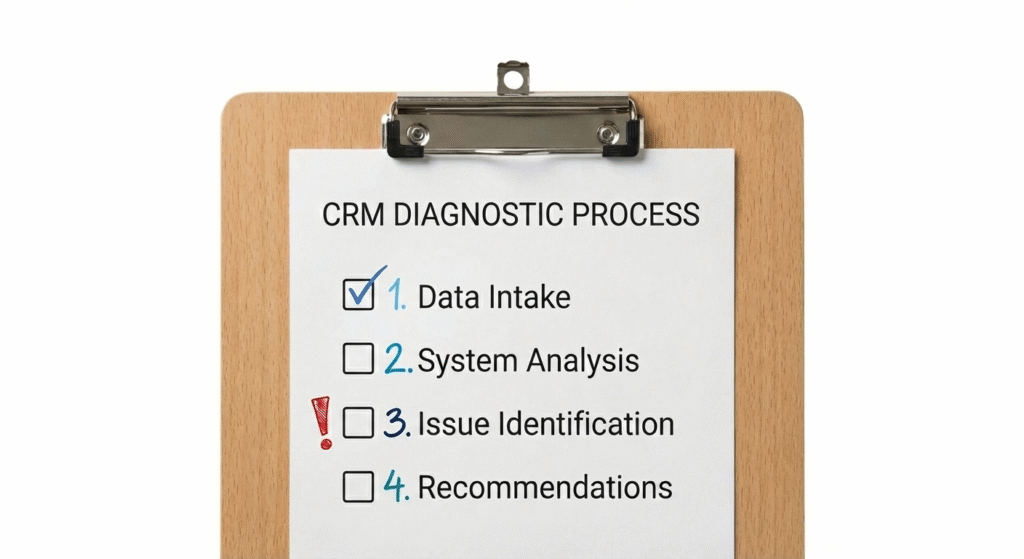
What Happens in the Diagnostic
Why We Only Take 8 Clients Per Year?
The reality of our business model: Deep diagnostic work and assembled specialist teams don’t scale infinitely.
Each client engagement requires:
Our personal attention throughout implementation
Before we invest your time or ours, we need to determine if we’re a fit.
What we’ll discuss:
- What prompted you to reach out now
- What you’ve tried already
- What’s actually broken vs. what you think is broken
- Whether your situation matches our expertise
What we’re assessing:
- Is this a problem we can solve?
- Is the timing right?
- Do you have the organizational support for change?
- Are we the right team, or should we refer you elsewhere?
- Do we have capacity to take you on within a reasonable timeframe?
Three outcomes:
- We’re a clear fit and have capacity – We’ll propose a diagnostic scope and timeline
- We’re not the right team – We’ll tell you why and refer you to someone who is
- You’re not ready yet – We’ll tell you what needs to happen first
The honesty part: If your budget is $20K and you need $80K worth of work, we’ll tell you. If your problem is actually your sales cadence (not your CRM), we’ll tell you. If another consultant would be better suited, we’ll tell you.
We’ve turned down projects because we weren’t the right fit. We’ve referred potential clients to competitors who specialize in areas we don’t. This is how we maintain quality.
If we’re a fit and have capacity, we conduct a thorough diagnostic to understand what’s actually going on and what we will propose including some assumptions about costs.
Investment: $5,000 – $15,000 depending on complexity
(If you proceed with implementation, we credit 50% toward your project)
Step 1: Data Health Assessment
What we analyze:
- Data completeness: Which critical fields are empty or unreliable?
- Data accuracy: Spot-check sample records against source systems
- Duplicate analysis: How many duplicate records exist? Which types?
- Data freshness: When was data last updated? How stale is it?
- Integration data flows: Where does data enter the system? Where does it leave?
How we do it:
- Automated data quality reports
- Manual sampling of records across objects
- User interviews about which data they trust (and don’t)
- Analysis of data entry patterns to identify problems
Deliverable: Data health scorecard with specific problem areas prioritized by business impact
Step 2: User Behavior & Adoption Analysis
What we analyze:
- Login frequency and patterns by user
- Feature utilization: Which capabilities are used vs. ignored?
- Data entry patterns: Who enters data regularly vs. in batches?
- Workarounds: Where are people using spreadsheets or external tools?
- Pain points: Where do users get stuck or frustrated?
How we do it:
- Usage analytics from Salesforce
- User interviews (we talk to people actually using the system daily)
- Shadow sessions watching real workflows
- Survey of common frustrations and desired improvements
Deliverable: Adoption report identifying which user groups are struggling and why
Step 3: Process & Integration Architecture Review
What we analyze:
Process gaps:
- Sales cadences: How do different reps work? Where does the system clash with reality?
- Service workflows: Where do cases get stuck or fall through cracks?
- Marketing handoffs: Where does lead information get lost between marketing and sales?
Integration architecture:
- Current integrations: What’s connected? How? How reliable?
- Missing integrations: What systems should talk but don’t?
- Data flow mapping: Where does data move between systems? What gets lost in translation?
- Integration monitoring: How do you know when something breaks?
How we do it:
- Process mapping sessions with each department
- Architecture review of current integrations
- Data flow documentation
- Integration error log analysis
Deliverable: Process flow diagrams showing gaps and integration architecture map showing current state and desired state
Step 4: Technical Debt & Customization Audit
What we analyze:
- Custom code: What’s been built? Is it necessary? Is it maintainable?
- Automation complexity: Which workflows/flows are helping vs. hurting?
- AppExchange apps: Which are providing value? Which are unused?
- Security and compliance: Are there configuration risks?
- Scalability: Where will you hit limits as you grow?
How we do it:
- Code review of custom Apex and Lightning components
- Flow and workflow documentation
- Security health check
- Capacity planning analysis
Deliverable: Technical debt report with recommendations for what to keep, refactor, or remove
1: Executive Summary
- The 3-5 things costing you the most money right now
- Priority order for fixing them
- Estimated cost and timeline for each fix
- Expected ROI for each investment
2: Detailed Findings
- Full data health assessment with examples
- User adoption analysis by department and role
- Process gap documentation with visual workflows
- Integration architecture current state and desired state
- Technical debt inventory with recommendations
3: Roadmap Options
- Option A: Quick wins (shorter, lower investment, meaningful impact)
- Option B: Comprehensive fix (higher investment, transforms the system)
- Option C: Hybrid approach (phased quick wins, then deeper work)
4: What Happens Next
- If you choose to work with us: Proposed team, timeline, investment
- If you choose to work with someone else: Recommendations on what to look for
- If you choose to fix it internally: Guidance on where to start
You own this roadmap regardless of whether you hire us.
Why the Diagnostic Is Paid
(And Why It’s Worth It)
The reality: Often a thorough diagnostic takes 60-100 hours of specialist time. Sometime its less depending how obvious the issues are.
We’re analyzing your data, interviewing your users, documenting your processes, reviewing your integrations, and auditing your technical configuration.
This isn’t a sales pitch disguised as discovery. This is real diagnostic work that produces a roadmap you can act on—whether you hire us or not.
What you’re really paying for:
- An honest, objective assessment from people who aren’t trying to sell you a predetermined solution
- A roadmap with clear priorities, not a wishlist
- The 50% credit toward implementation removes the cost if you proceed